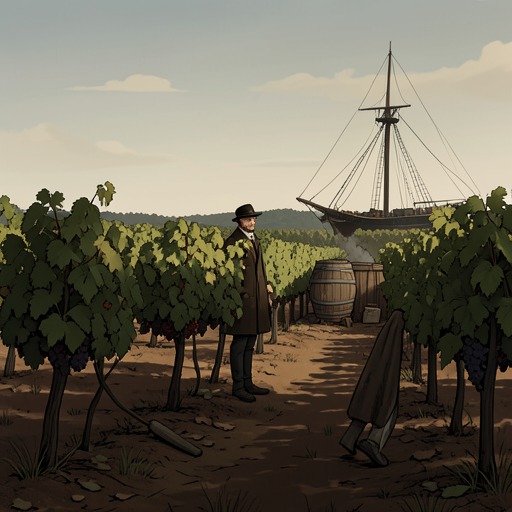
Vincenzo Florio’s Marsala wine venture
The Florios of SicilyVincenzo Florio’s Marsala wine venture is a deliberate expansion of Casa Florio into wine production, organized around a cellar partnership with Raffaele Barbaro and a strategy of quality rather than volume. It turns a commercial opportunity into a plan for production, labor, and wider markets, while echoing the ambition and social tensions that shape the Florio rise.
Origins and Partnership
Vincenzo proposes a partnership between Raffaele, Ignazio, and himself. Rather than employ Raffaele merely to oversee the business, he wants him to have a stake in its finances. Raffaele has already set money aside to buy the land, and Vincenzo proposes a division in which Raffaele receives one third and Casa Florio two thirds. The arrangement makes Raffaele a participant in the enterprise, not simply a subordinate in the family firm.
Raffaele accepts despite his anxiety about working with Vincenzo, whom he has come to know as a difficult man. The offer is valuable both economically and socially: it could make him an important figure in Marsala, where he would otherwise remain Don Florio’s cousin and one of his factotums in Palermo. Vincenzo presents the partnership as a genuine commitment and warns that running the cellar will not be easy, especially with British interests established in Marsala.
Production and Market Strategy
Vincenzo imagines the venture as a working enterprise: wagons in the courtyard, barrels stacked in pyramids, and bottles carrying the FLORIO label. He expects the firm’s wine to stand out through quality. In contrast to producers who supply wine for soldiers and reserve only a few barrels for the highest grade, the Florio cellar will concentrate on quality and pursue different markets, including France and Piedmont.
The plan belongs to a wider commercial outlook. When discussing a new sulfur consignment with Tommaso Portalupi, Vincenzo says that a quarter of the production is reserved for Portalupi alone. He also points to sales agents in Naples and Marseille and to established contacts in Piedmont and Lombardy. Wine is thus presented alongside sulfur as part of an expanding business whose reach depends on both production and commercial networks.
Vincenzo also gives the cellar a particular standard for managing its workforce. He tells Raffaele to speak with the workers and look them in the face, insisting that they should understand it is an honor to work there. The instruction makes labor relations part of his vision for the enterprise: the cellar is not to be treated as interchangeable with other producers, but as a workplace whose standing should be recognized by those employed in it.
Place in the Florio Business
The venture draws on the commercial conditions in which the Florios have built their position. Spices and other imported goods pass through long chains of transport and handling before reaching European markets, while British and French merchants supply Mediterranean ports with colonial goods. In Palermo, wholesalers such as the Florios store merchandise in rented rooms at Palazzo Steri, paying import tariffs when goods enter the city rather than while they remain in transit. Their stock includes products sourced through British and French routes and traded across Mediterranean ports. This background clarifies the business pattern that the wine cellar extends: securing goods, arranging storage and sale, and connecting local enterprise to broader markets.
Marsala wine also sits within an economy of commodities whose value depends on labor and the control of trade. Sicily’s sulfur, for example, is extracted by men and children who carry baskets of yellow stone from underground corridors; the material is then weighed, packed, and shipped to Europe, particularly Britain. The wine venture follows a different production model, but likewise treats a Sicilian product as the basis for a market extending beyond the island.
Commercial Ambition and Social Status
The cellar’s projected success belongs to Vincenzo’s larger effort to secure Casa Florio’s future. He regards what he and Ignazio have built as an inheritance that must be safeguarded and passed on, and he associates its continuity with securing an heir and a suitably genteel marriage for his son. Commercial accomplishment, in this family logic, is both wealth and a legacy to protect.
Yet economic success does not erase inherited distinctions. Vincenzo’s pursuit of Isabella Pillitteri is rejected by her family on the grounds that he is a shop boy, despite his money; the baroness insists that blood, not wealth, determines social standing. Later, when Vincenzo’s daughters are discussed as possible marriage partners, Gabriele Chiaramonte Bordonaro makes clear that business relations do not mean acceptance into his family: the daughters were born in particular circumstances. At an aristocratic gathering, Giulia feels that her lace and dress cannot overcome the guests’ judgment of her as a bourgeois woman who has become a wife.
The venture therefore represents both material expansion and an unfinished claim to recognition. Vincenzo’s confidence rests on work, commodities, ships, and Casa Florio, while the social world around him continues to distinguish commercial wealth from inherited nobility. The Marsala cellar gives that ambition a concrete form: a new product, a shared investment, a quality-led market plan, and a name intended to travel beyond Sicily.